
English


Views: 0 Author: Site Editor Publish Time: 2026-07-22 Origin: Site


Transitioning from batch processing to a continuous, automated operation requires massive capital expenditure. This makes equipment selection a high-stakes decision for commercial bakeries. Misaligning equipment capabilities with dough rheology, facility constraints, or future throughput targets results in production bottlenecks. It causes inconsistent product quality and stranded capital. You need a technical framework for evaluating manufacturers and assessing system specifications. This guide helps you select an industrial bakery production line engineered for your specific product mix and operational goals. We break down the hardware requirements, facility layout engineering, and integration strategies necessary for high-volume baking. You will learn how to match mechanical handling to dough characteristics and plan for long-term scalability.

Dough Rheology Dictates Hardware: Equipment must be matched to specific dough characteristics (hydration levels, resting times, handling stress) rather than relying solely on manufacturer throughput claims.
Modularity Equals Future-Proofing: Flexible, modular lines offer superior protection against SKU proliferation compared to rigid, single-product systems.
Sanitary Design is Non-Negotiable: Compliance with stringent food safety standards (FSMA, EHEDG, FDA) must be engineered into the line's fundamental architecture, not added as an afterthought.
Table of Contents
Establishing clear success criteria prevents over-engineering and ensures the system meets exact operational demands. You must balance throughput targets with the physical realities of your facility and the chemical properties of your dough. Hardware must adapt to the dough, not the other way around.
Begin by establishing baseline capacity requirements measured in kilograms per hour or units per minute. High-speed automation often introduces mechanical stress to the dough structure. You must define acceptable tolerances for product consistency, including weight accuracy, volume, and crumb structure. Analyze product giveaway metrics to understand how precise portioning and dividing accuracy directly impact ingredient utilization at scale. Identify the exact threshold where automation risks compromising artisanal quality or cellular structure.
When scaling up, bakeries often face a direct conflict between speed and quality. A divider running at 120 strokes per minute might achieve the volume targets but could degas a highly fermented dough, ruining the final crumb. You have to map out the acceptable deviation in piece weight. If your target is a 500g loaf, a +/- 5g variance might be acceptable, but a +/- 15g variance will destroy your ingredient yield over a year of continuous shifts.
Document exact hydration levels, fermentation times, and required resting phases for your entire product portfolio. Evaluate the mechanical stress tolerance of your primary dough types. Highly hydrated sourdough requires completely different handling mechanics than stiff laminated pastry dough. Determine the necessity of stress-free sheeting systems versus traditional extrusion or volumetric dividing methods to maintain the desired open crumb structure.
Dough Type | Hydration Level | Handling Requirement | Recommended Equipment |
|---|---|---|---|
Artisan / Sourdough | 75% - 85% | Low shear, minimal degassing | Stress-free sheeting lines, gravity-fed dividers |
Standard Pan Bread | 60% - 65% | Consistent volumetric portioning | Volumetric ram-and-knife dividers |
Laminated Pastry | 50% - 55% (plus fat) | Temperature control, gentle reduction | Multi-roller sheeters, resting conveyors |
Hamburger Buns | 55% - 60% | High-speed rounding, exact weight | Continuous extrusion dividers, rotary rounders |
Understanding these rheological parameters prevents you from buying a high-speed volumetric divider for a ciabatta line. The mechanical action of forcing highly hydrated, fermented dough into a volumetric chamber will destroy the gas pockets. You need a stress-free system that gently sheets the dough into a continuous web before cutting it into individual portions.
An advanced system holds no value if it cannot physically fit or operate within your plant. Audit available floor space, ceiling height, structural load capacities, and access routes for installation. Map existing utility infrastructure, paying close attention to electrical load capacity, natural gas lines, water pressure, compressed air, HVAC, and industrial drainage. Plan for optimal material flow from raw ingredient intake through processing, packaging, and dispatch to prevent cross-contamination and minimize forklift traffic.
Conducting a proper facility audit requires looking beyond the footprint of the machinery. You must account for operational clearances, maintenance access, and utility drops.
Measure the exact clear height under roof trusses to ensure spiral coolers or proofers can fit with adequate ventilation space above them.
Verify the concrete slab thickness and load-bearing capacity, especially in the oven zone, as industrial tunnel ovens exert massive static loads.
Map the drainage layout. Washdown zones require sloped floors leading to trench drains equipped with proper catch basins for dough scraps.
Calculate the makeup air requirements for the oven burners to prevent negative pressure situations inside the bakery.
Designate specific forklift routes that do not intersect with open product zones to maintain food safety standards.
Selecting the right architectural framework determines your operational flexibility. Bakeries must choose between continuous flow, batch processing, and various integration strategies based on their specific product mix. The configuration you choose will dictate your labor requirements and changeover times for the next two decades.
Evaluate the labor reduction benefits and consistency of fully continuous systems against the operational flexibility of semi-automated setups. Continuous lines excel in high-volume, uniform production environments where dough flows without interruption from mixing to packaging. Assess semi-automated configurations for operations requiring frequent human intervention, complex finishing steps, or highly variable fermentation times.
A fully continuous line requires absolute control over ambient conditions and ingredient consistency. If the ambient temperature spikes, the dough ferments faster on the conveyor, and you cannot simply pause a continuous tunnel oven. Semi-automated lines allow operators to buffer racks in retarder-proofers, giving them control over the fermentation timeline. This buffering capacity is critical for bakeries dealing with unpredictable ambient conditions or highly variable artisan products.
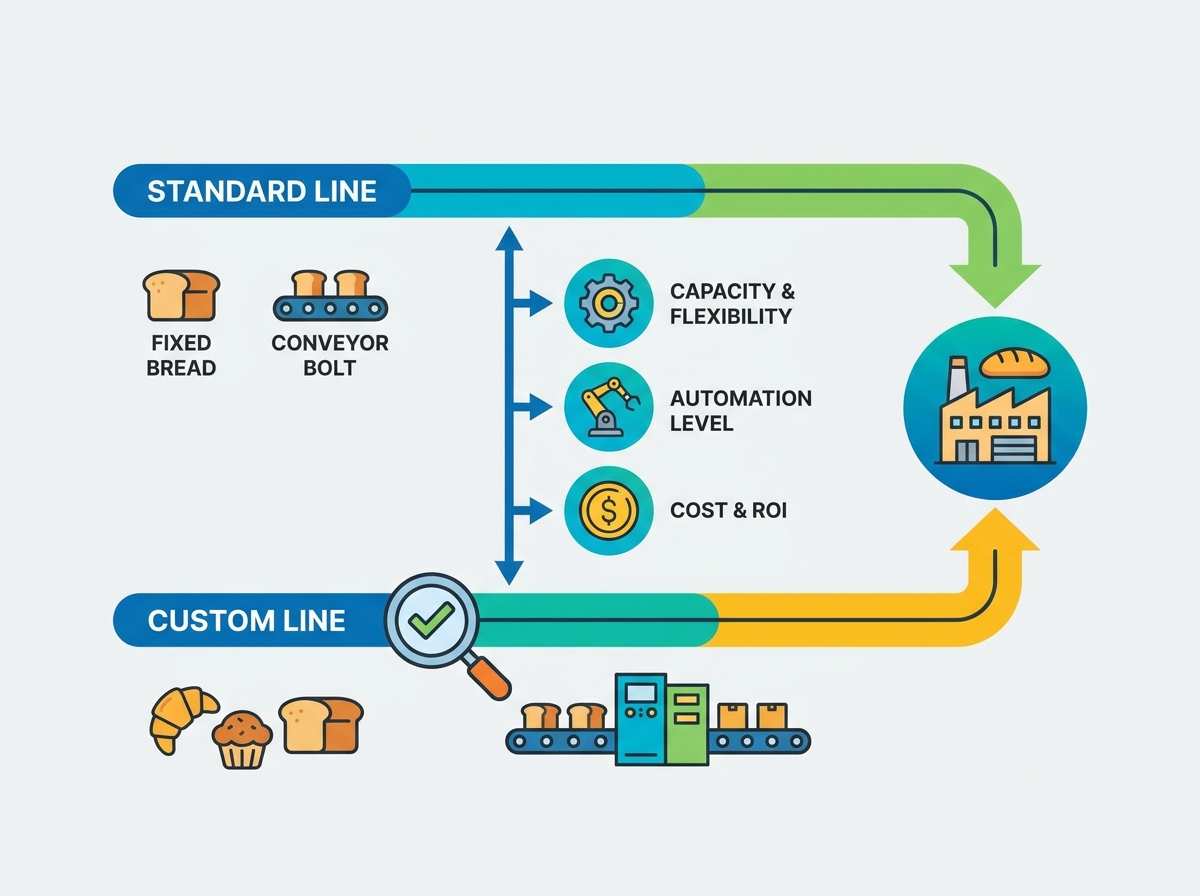
Dedicated lines offer maximum efficiency and high-volume output for standardized items like standard pan bread or hamburger buns. They minimize changeover downtime but lack adaptability. Flexible lines feature quick-changeover capabilities for diverse product portfolios, accommodating laminated pastries, artisan loaves, and varying formats on the same footprint. When evaluating flexible systems, scrutinize the changeover mechanics. Look for the implementation of Single-Minute Exchange of Die (SMED) principles, toolless changeovers, and motorized adjustment recipes.
If you run a flexible line, the changeover process must be heavily engineered. Swapping out cutting rollers, stamping dies, or rounding belts should not require a mechanic with a toolbox. Operators should be able to release quick-cam levers, swap the tooling, and select the new product recipe on the HMI. The PLC should then automatically adjust conveyor speeds, roller gaps, and guillotine timing to match the new SKU.

Analyze the operational impact of sourcing an end-to-end line from a single Original Equipment Manufacturer (OEM). Turnkey solutions provide a single point of accountability, seamless software integration, and standardized parts. Compare this against integrating specialized modules from multiple vendors. The best-of-breed approach optimizes for the highest-performing individual mixer, oven, and packaging unit but assumes significantly higher integration risk and complex control architecture mapping.
Integration Strategy | Primary Advantage | Primary Disadvantage | Best Suited For |
|---|---|---|---|
Turnkey (Single OEM) | Single point of accountability, unified controls | May compromise on specific module performance | Standardized bread lines, new facility builds |
Best-of-Breed (Multi-Vendor) | Maximum performance for each specific process step | High integration risk, complex troubleshooting | Highly specialized artisan or pastry operations |
A comprehensive evaluation requires analyzing every distinct phase of the baking process. Each module must perform its specific function while maintaining perfect synchronization with upstream and downstream equipment. A bottleneck in the cooling phase will force you to slow down the mixer, destroying the efficiency of the entire operation.
Evaluate raw material storage and pneumatic conveyance systems, including outdoor silos and indoor big bag stations. Assess gravimetric versus volumetric dosing systems for flour, water, yeast, and micro-ingredients. Gravimetric systems provide superior batch-to-batch repeatability by measuring exact weight rather than volume, compensating for variations in ingredient density and aeration.
Flour density changes based on humidity and how long it has been sitting in the silo. If you use volumetric dosing, a cubic meter of aerated flour will weigh significantly less than a cubic meter of compacted flour. This throws off your hydration ratios. Gravimetric dosing uses load cells to measure the exact mass of the ingredients dropping into the mixer. You also need automated temperature control for the water dosing system to hit your final dough temperature targets consistently.
Compare continuous mixing systems against automated batch mixing. Continuous mixing delivers consistent dough temperature, uniform hydration, and reduced manual intervention. Automated batch mixing remains superior for highly varied product mixes and doughs requiring long, specific fermentation phases. Evaluate automated dough transport systems, such as specialized pumps, bowl elevators, conveyors, and Automated Guided Vehicles (AGVs), ensuring they move dough without inflicting unnecessary shear stress.
When moving dough from the mixer to the makeup equipment, the transport mechanism matters. Pumping stiff dough through long pipes generates friction, which raises the dough temperature and alters the yeast activity. For sensitive doughs, bowl elevators that hoist the entire mixing bowl and gently dump the contents into the divider hopper are far superior. If you use chunkers to feed the hopper, ensure the cutting blades are coated with non-stick materials to prevent tearing the gluten network.
Assess proofer configurations based on footprint efficiency and climate control precision. Spiral, step, pocket, or tray proofers must maintain exact temperature and relative humidity parameters. Evaluate industrial oven types—tunnel, spiral, or multi-deck—and their heat transfer methods. Choose between cyclothermic, direct gas-fired, impingement, or thermal oil based on the required crust characteristics and bake times. Review energy recovery systems and thermal profiling capabilities to minimize utility consumption and environmental impact.
The oven is the heart of the bakery. Its thermal dynamics dictate the final product quality. Direct Gas-Fired (DGF) ovens provide intense, radiant heat ideal for rapid crust formation on products like pizza bases or flatbreads. Cyclothermic ovens use indirect heat, circulating hot air through tubes above and below the baking band. This provides a gentler, more even bake suitable for pan breads and delicate pastries. Thermal oil ovens offer massive heat retention and absolute temperature stability, making them perfect for heavy, dense artisan loaves that require a strong bottom bake.
Determine requirements for ambient versus active or vacuum cooling systems. Proper cooling prevents condensation, preserves crumb structure, and mitigates mold growth. Evaluate synchronization capabilities between the cooling discharge, slicing mechanisms, and automated wrapping, bagging, or cartoning equipment. Misalignment in this final stage causes severe bottlenecks and product damage.
You cannot slice bread until the core temperature drops below 35 degrees Celsius. If you slice it too warm, the crumb will gum up the slicer blades, causing tearing and massive product loss. Spiral coolers maximize vertical space, but you must calculate the exact retention time based on your heaviest product. Vacuum cooling is an emerging technology that rapidly drops the core temperature by manipulating atmospheric pressure, drastically reducing the cooling footprint and locking in moisture.

Verify washdown ratings, prioritizing IP69K for electrical enclosures in wet cleaning zones. Evaluate accessibility for sanitation crews. Look for sloped surfaces, minimal catch points, and tubular stainless-steel framing to prevent organic accumulation and bacterial harborage. Assess Clean-in-Place (CIP) capabilities for liquid handling systems, mixing components, and areas requiring frequent allergen washdowns.
Sanitation downtime eats directly into your production schedule. Equipment must be designed for rapid, thorough cleaning. Avoid flat horizontal surfaces where flour dust can settle. All framing should be constructed from diamond-oriented square tubing or round tubing. Belts should feature quick-release tensioners so sanitation crews can clean underneath them without requiring maintenance personnel to dismantle the conveyor.
Long-term viability relies on efficient resource utilization, robust maintenance frameworks, and the ability to adapt to future technological advancements. You must look past the initial purchase price and evaluate the ongoing operational expenses.
Model the operational impact of energy-efficient motors (IE3/IE4) and highly insulated ovens on utility consumption. Calculate labor efficiency gained through automated changeovers, automated product inspection via vision systems, and reduced manual handling. Factor in yield improvements and the reduction of raw material waste achieved through real-time process monitoring and precise dosing controls.
An oven with 300mm of high-density rockwool insulation and a heat recovery system will cost significantly more upfront than a standard oven. However, the reduction in natural gas consumption will offset that premium within the first few years of operation. Similarly, investing in a vision inspection system that automatically rejects deformed products before they enter the packaging machine saves on wasted packaging materials and prevents downstream jams.
Review Service Level Agreements (SLAs), guaranteed response times, and the geographical proximity of spare parts depots. Assess the availability of local field technicians and the OEM's remote diagnostic capabilities, including IIoT integration and augmented reality support. Determine the ratio of standard, off-the-shelf components to proprietary parts to avoid future supply chain bottlenecks.
If a drive motor fails at 2:00 AM on a Saturday, you need to know exactly how to get the line running again. If the OEM uses proprietary servo motors that ship from Europe with a three-week lead time, your operation is dead in the water. Mandate that the manufacturer utilizes standard, locally available components for critical wear parts. Bearings, belts, sensors, and variable frequency drives (VFDs) should be easily sourced from local industrial suppliers.
Evaluate the control architecture (PLC/HMI platforms) for future software upgrades, SCADA integration, and ERP connectivity. Assess built-in Overall Equipment Effectiveness (OEE) tracking tools and predictive maintenance software. Identify physical capacity buffers built into the line design to accommodate future volume increases without requiring a full system replacement.
Your control system must provide actionable data. Modern lines should track motor amperage, oven zone temperatures, and fault codes in real-time. This data feeds into predictive maintenance algorithms. If the amperage on a mixer drive motor slowly increases over a month, the system should flag the bearings for inspection before a catastrophic failure occurs during a production run.
Execution is just as critical as equipment selection. Structured testing and strategic commissioning prevent extended downtime and operational failures. You must control the installation environment and validate performance at every step.
Mandate a rigorous FAT at the manufacturer's facility using your actual ingredients and flour types. This validates performance metrics and dough behavior before the equipment ships. Define clear, legally binding SAT protocols to ensure the equipment performs exactly to specification once integrated into your facility's unique environment.
Do not accept a dry-run FAT. Running empty conveyors proves nothing. You must ship your specific flour, yeast, and water to the manufacturer's testing facility. Run the equipment at full speed with real dough. Check the piece weight accuracy, monitor the dough temperature after mixing, and verify the changeover times. If the equipment fails to meet the agreed-upon metrics during the FAT, the manufacturer must engineer a solution before the machinery leaves their floor.
Acknowledge the skills gap when transitioning staff from manual baking to operating complex PLC-driven machinery. Require comprehensive, on-site training programs, virtual simulation tools, and accessible digital documentation from the OEM to ensure your team can independently operate and troubleshoot the system.
Your best bakers are not necessarily your best machine operators. Operating an automated line requires an understanding of HMI navigation, sensor logic, and mechanical timing. The OEM must provide hands-on training during the commissioning phase. Operators need to learn how to recover from a fault, how to safely clear a jam, and how to perform daily preventative maintenance tasks.
Develop a strategic installation timeline. Evaluate the risks of a weekend hard cut-over versus a phased installation that runs parallel to existing production. Phased commissioning minimizes downtime and provides a safety net while operators acclimate to the new technology.
Install and commission the bulk handling and mixing systems first, feeding the dough into your existing makeup equipment.
Install the new makeup and proofing lines, running them in parallel with the old lines to build operator confidence.
Commission the new oven during a scheduled shutdown, ensuring all exhaust stacks and gas lines are fully certified.
Integrate the cooling and packaging systems, conducting extensive dry runs to verify synchronization.
Execute a final, full-line wet run to validate the entire process flow before decommissioning the legacy equipment.
Choosing the right industrial bakery production line is essential for increasing production capacity, ensuring consistent product quality, and supporting long-term business growth. A well-designed automated production system enables bakeries to optimize workflow, reduce operating costs, and respond more efficiently to changing market demands.
At Baker's Kingdom, we specialize in advanced industrial bakery production lines and customized baking equipment solutions for commercial manufacturers worldwide. Our engineering expertise and complete automation systems help customers improve productivity, enhance product consistency, and achieve sustainable growth with reliable, high-performance bakery technology.
Before investing in an industrial bakery production line, carefully evaluate your product portfolio, dough characteristics, production targets, factory layout, automation requirements, and future expansion plans to ensure the most suitable long-term production solution.
A: Lead times generally range from 6 to 12 months. This depends heavily on the system's complexity, the level of custom engineering required, and current supply chain conditions for specialized electronic components.
A: Yes, flexible multi-product lines equipped with stress-free sheeting systems and modular make-up stations can handle both. The equipment must feature rapid, toolless changeovers to make this operationally viable.
A: Look for tubular stainless-steel framing, sloped surfaces to prevent water pooling, IP69K-rated electrical enclosures, and minimal catch points. These features eliminate bacterial harborage zones and speed up sanitation.
A: Continuous mixing feeds ingredients uninterrupted into a mixing chamber, ideal for high-volume, uniform doughs. Automated batch mixing processes discrete quantities, offering better control for long fermentation times and varied product mixes.
A: Specify open-architecture PLC platforms and require SCADA integration capabilities from the OEM. Ensure the control system supports standard industrial communication protocols like OPC UA or Ethernet/IP.
A: With rigorous preventative maintenance, timely component upgrades, and adherence to OEM service schedules, industrial baking systems typically operate efficiently for 15 to 25 years.


