
English


Views: 0 Author: Site Editor Publish Time: 2026-08-05 Origin: Site


Incorporating fruit inclusions at a commercial scale introduces complex variables into dough rheology. Improper handling leads to compromised crumb structure, uneven distribution, and inconsistent product quality. For bakeries producing raisins for bread, mastering the integration of these dried fruits is critical to maintaining production efficiency and brand reputation.
Unconditioned or improperly sized inclusions cause severe moisture migration, often referred to as staling. They tear the gluten network during mixing and sink to the bottom of the pan, directly impacting shelf life, visual appeal, and slicing efficiency. Addressing these issues requires strict control over ingredient preparation and dough handling.
Establishing standardized protocols for selecting, conditioning, and dosing protects the dough matrix. It ensures batch-to-batch consistency and optimizes the final product for both sensory appeal and extended shelf life. Understanding the science behind hydration and mixing mechanics forms the foundation of successful commercial fruit bread production.
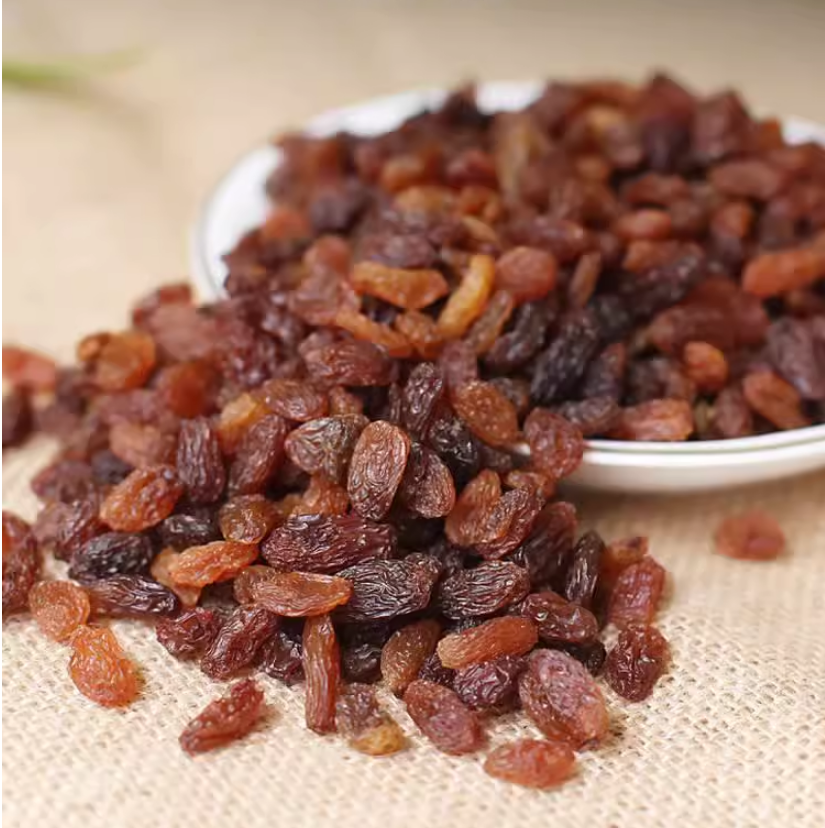
Conditioning is Mandatory: Raw raisins act as desiccants; proper temperature-controlled hydration prevents them from stealing moisture from the baked crumb, which accelerates staling.
Size Dictates Distribution: Midget raisins offer higher piece-count per pound, ensuring better distribution and less structural interference in the dough compared to standard select sizes.
Late-Stage Incorporation: Adding inclusions only during the final minutes of mixing prevents fruit maceration and protects the developed gluten network from mechanical shear.
Water Activity (Aw) Management: Balancing the moisture content of the conditioned fruit with the dough is critical to preventing microbial growth and extending commercial shelf life.
Table of Contents
Selecting the wrong varietal or size leads to inconsistent flavor profiles, uneven distribution, and structural weaknesses in the final loaf. Procurement teams must evaluate the physical and chemical properties of the fruit before formulation begins. The choice between different drying methods and grape varieties fundamentally alters the fermentation dynamics and the final crumb structure.
Thompson seedless and golden raisins originate from the same grape variety but undergo entirely different drying processes. Natural sun-dried Thompson raisins offer a robust, caramelized flavor and dark color, making them the traditional choice for standard bakery applications. Golden raisins are mechanically dehydrated and treated with sulfur dioxide to preserve their light color, resulting in a fruitier, tangier profile that appeals to specific artisan formulations.
The sulfites in golden raisins heavily impact yeast activity and fermentation times. In commercial yeast systems, high concentrations of sulfites retard proofing. When formulating sourdough systems, sulfite residues inhibit wild yeast strains and lactic acid bacteria (LAB) more significantly than commercial Saccharomyces cerevisiae. Bakers must adjust fermentation schedules or yeast dosages when switching between natural and golden varieties to maintain consistent proofing times.
Raisin Type | Drying Method | Flavor Profile | Fermentation Impact | Best Application |
|---|---|---|---|---|
Natural Thompson | Sun-dried | Caramelized, robust | Minimal interference | Standard commercial loaves |
Golden | Mechanical + SO2 | Fruity, tangy | Retards wild yeast/LAB | Artisan and specialty breads |
Zante Currants | Sun-dried | Intense, tart | Minimal interference | Dense fruitcakes, buns |
Raw, unpasteurized raisin skins carry natural microflora, including wild yeasts and environmental bacteria. In long-fermentation sourdough or poolish systems, introducing unwashed fruit triggers spontaneous secondary fermentation. This alters the intended flavor profile, increases dough acidity unpredictably, and can lead to over-proofing in the final stages of production.
Pasteurization or thorough washing during the conditioning phase mitigates this risk. Heat treatment reduces the microbial load on the skin, ensuring the commercial yeast or cultivated sourdough starter remains the dominant fermentation driver. Facilities utilizing ambient temperature soaking must monitor soaking times strictly to prevent the soak water itself from fermenting before incorporation.
Piece-count per pound is a critical metric for commercial bakers. Standard select raisins typically range from 900 to 1,200 pieces per pound, while midget raisins exceed 1,300 pieces per pound. Smaller inclusions reduce the risk of dough tearing during mixing and slicing, as they navigate through the gluten matrix with less resistance.
Midget raisins improve the visual density of fruit in the slice without increasing the total dosage weight. This provides a better consumer experience, as every bite contains fruit, while maintaining the structural integrity of the gluten network. Larger fruit often creates heavy pockets that collapse the surrounding crumb during the bake.
Commercial purchasing specifications must define acceptable baseline moisture content, typically between 15% and 18%. Fruit arriving below 15% requires extended conditioning times, while fruit above 18% risks clumping in the hopper and premature mold growth in storage. Additionally, strict tolerances for stems and cap stems are necessary to prevent foreign material contamination and protect high-speed slicing equipment from blade damage.
Proper hydration of dried fruit is non-negotiable in commercial baking. Unconditioned fruit acts as a sponge, pulling water from the surrounding dough through osmotic pressure during proofing and baking. This results in a dry, crumbly loaf with a significantly reduced shelf life. Conditioning protocols must be standardized across all shifts.
Industry-standard conditioning protocols emphasize strict temperature control. The target fruit temperature at the end of conditioning must stabilize near 75°F (24°C) to match target dough temperatures and avoid shocking yeast populations. Introducing cold fruit drops the dough temperature, retarding fermentation, while hot fruit accelerates yeast activity and degrades the gluten network.
Weigh the dry fruit accurately according to the batch sheet requirements.
Submerge the fruit in temperature-controlled water (typically 75°F to 80°F).
Agitate gently to break up clumps and ensure even water contact across all pieces.
Allow the fruit to soak for the designated time based on the hydration method (ambient vs. vacuum).
Drain thoroughly using stainless steel screens or centrifugal systems to remove all surface moisture.
The overnight cold-soak method (8 to 12 hours) provides optimal slow, low-temperature hydration. This preserves skin structural integrity and prevents sugar leaching. For high-throughput lines, rapid vacuum hydration and steam injection accelerate conditioning to under 30 minutes, though these methods require precise calibration to prevent skin rupture and subsequent mushiness.
Excessively hot water must be avoided at all costs. High temperatures cause flavor loss, skin degradation, sugar leaching, and a mushy texture that breaks down entirely during the mixing phase, turning the dough a muddy brown color.
Thorough draining is essential after conditioning. Fruit should rest on screens or pass through centrifugal dryers for 2 to 4 hours to remove surface water. Excess surface water artificially increases dough hydration, leading to sticky, unmachinable dough that causes line stoppages at the divider and rounder.
Operators must verify that the fruit feels plump but dry to the touch before incorporation. If the fruit leaves visible water pools in the holding bins, it requires further draining. Some facilities utilize a light dusting of bakery flour over the drained fruit to absorb residual surface moisture and prevent clumping in automated feeders.
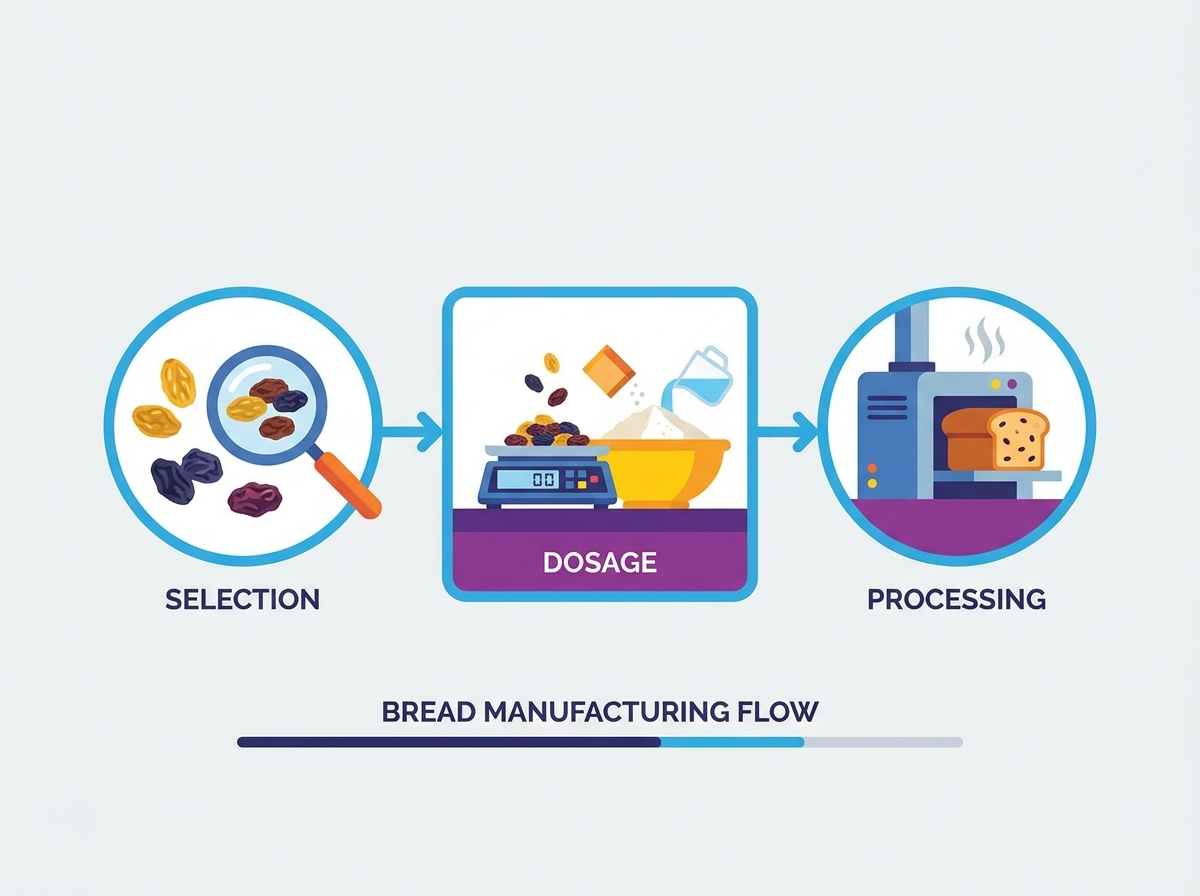
Balancing sensory expectations with structural limits and cost-in-use dictates the formulation strategy. The dosage must provide adequate visual and flavor impact without collapsing the dough structure. Formulators must calculate the exact weight of the inclusions relative to the flour weight to maintain consistency.
Typical baker's percentages for raisin bread range from 25% to 50% based on flour weight. Pushing beyond 50% often exceeds the structural threshold, where the gluten network can no longer support the inclusion weight, resulting in poor volume and dense crumb structure. High-inclusion doughs require stronger flour with higher protein content to support the added mass.
Bread Style | Baker's Percentage (Fruit) | Flour Protein Requirement | Mixing Strategy |
|---|---|---|---|
Standard Sandwich Loaf | 25% - 30% | 11.5% - 12.5% | Standard late-stage addition |
Premium Artisan Boule | 35% - 45% | 12.5% - 13.5% | Gentle fold-in post-mix |
Dense Fruit Loaf | 50% - 65% | 13.5%+ | Reinforced gluten matrix required |
Inclusion suspension differs significantly between yeast-leavened doughs and chemically leavened quick breads. Quick breads lack a gluten matrix, relying entirely on batter viscosity and starch gelatinization to support heavy fruit. Formulators must adjust the batter viscosity using gums or modified starches to prevent sinking during the initial baking phase before the crumb sets.
In yeast-leavened systems, the developed gluten network acts as a physical net, holding the fruit in place. However, if the dough is over-mixed or over-hydrated, this net weakens, allowing the heavy inclusions to migrate downward during the final proof.
Total dough hydration must be recalculated to account for the residual moisture introduced by conditioned fruit. Even well-drained fruit carries internal moisture that migrates into the dough during mixing and proofing. Reducing the base water by 2% to 5% often compensates for this variable, preventing the dough from becoming overly slack.
Bakers must conduct absorption tests on each new crop of fruit, as natural variations in skin thickness and initial moisture content affect how much water the fruit retains during conditioning. Failing to adjust base hydration leads to inconsistent dough handling at the makeup equipment.
Natural sugars leaching from the fruit during mixing accelerate yeast activity initially, providing readily available food for the yeast. However, excessive free sugars increase osmotic stress on the yeast cells, potentially retarding fermentation later in the process. Formulators must balance added formula sugars (like sucrose or high fructose corn syrup) with the natural fructose and glucose provided by the fruit.

Mechanical shear during mixing crushes the fruit, discolors the dough, and causes inclusions to sink during proofing. Strict mixing protocols are required to maintain fruit integrity and ensure even distribution throughout the dough mass.
Late-stage incorporation is mandatory. Fruit should be added only during the last 1 to 2 minutes of mixing on low speed, after full gluten development is achieved. This protects the gluten network from tearing and prevents the fruit from macerating into a paste. If the fruit is added too early, the friction of the mixing process destroys the skins, releasing acids and sugars that break down the dough structure.
Inclusions falling to the bottom of the pan is a common issue, particularly in high-hydration artisan doughs (75%+), where lower viscosity accelerates sinking. Ensuring adequate dough viscosity and proper fruit draining are the primary mitigation strategies. A slack dough simply cannot hold the weight of the hydrated fruit.
Lightly dusting the conditioned fruit with starch or flour creates friction within the dough matrix, helping to suspend the pieces evenly throughout the loaf during proofing and baking. Additionally, ensuring the dough is properly degassed during the makeup stage prevents large air pockets from forming around the fruit, which can exacerbate sinking.
Mixer design heavily impacts fruit integrity. Spiral mixers generally handle inclusions more gently than planetary mixers, as the bowl rotation folds the fruit into the dough rather than beating it. On continuous industrial baking lines, automated dry-dosing hoppers and inclusion feeders must be calibrated to prevent skin tearing and premature crushing before the fruit enters the dough mass.
Auger-style feeders often pinch and tear the fruit if the tolerances are too tight. Vibratory feeders are preferred for delicate inclusions, as they move the fruit along a tray without mechanical compression. Regular inspection of the feeder mechanisms is required to prevent buildup of sticky fruit residue.
Inclusion management directly correlates to product longevity and food safety. Controlling moisture dynamics is the most critical factor in extending commercial shelf life and preventing premature spoilage.
The moisture of the raisin must balance with the moisture of the crumb. Improper conditioning creates localized high-Aw pockets around the fruit, accelerating mold growth and reducing shelf life. Consistent hydration protocols ensure uniform water activity throughout the loaf, ideally targeting an Aw below 0.90 for standard commercial bread.
Quality control teams must utilize water activity meters to test both the crumb and the fruit inclusions independently after baking and cooling. If the fruit registers a significantly higher Aw than the surrounding crumb, the conditioning protocols must be adjusted to reduce total water uptake.
High percentages of fruit inclusions require adjustments to preservative levels. Dosages of calcium propionate or cultured wheat should be evaluated to handle the increased moisture load and potential localized high-Aw areas introduced by the fruit. The natural acidity of the fruit can sometimes lower the overall pH of the dough, which actually improves the efficacy of organic acid preservatives.
Fruit drag on commercial slicer blades causes loaf tearing and uneven slices. Blade lubrication and specific slicing temperatures are necessary to maintain clean cuts and high-speed packaging efficiency. Loaves must be fully cooled to an internal temperature of 90°F to 95°F before slicing to ensure the crumb is fully set.
Scalloped blades generally perform better than straight blades when slicing heavy fruit breads, as they puncture the tough fruit skins rather than dragging them through the crumb. Regular blade replacement schedules must be strictly enforced, as dull blades exacerbate tearing and crumb compression.
Conduct pilot batch testing to calibrate conditioning times based on the specific moisture content of incoming fruit shipments.
Adjust base hydration formulas to account for surface moisture, reducing formula water by 2% to 5% to maintain consistent dough rheology.
Standardize the timing of inclusion in the mixing cycle, ensuring fruit is added only during the final two minutes on low speed.
Implement strict draining protocols using screens or centrifugal dryers to eliminate excess surface water before dough incorporation.
Upgrade slicing equipment with scalloped blades and enforce strict cooling parameters to prevent loaf tearing during packaging.
Successful commercial raisin bread production depends on coordinating fruit specifications, conditioning parameters, dough hydration, mixing timing, and post-baking quality controls. With nearly three decades of baking industry experience, Baker's Kingdom combines bakery ingredients, food machinery, application support, and whole-plant planning to help commercial producers build more standardized and efficient production systems.
Its integrated operations—including bakery equipment manufacturing, ingredient processing, and a dedicated Turpan raisin factory—enable the company to support customers from raw-material selection and formulation development through equipment configuration and scaled production.
A: Raisins sink when the dough viscosity is too low to support their weight, often seen in high-hydration recipes. Excess surface moisture on the fruit also reduces friction. Dusting conditioned fruit with flour and ensuring proper dough development helps suspend them evenly.
A: The optimal method is an overnight cold-soak for 8 to 12 hours. For high-speed lines, vacuum hydration or steam injection can reduce this to under 30 minutes, provided the final fruit temperature stabilizes near 75°F (24°C).
A: Midget raisins are generally preferred for commercial baking. Their smaller size provides a higher piece-count per pound, ensuring better visual distribution and reducing the risk of tearing the gluten network during mixing and slicing.
A: Unconditioned fruit absorbs moisture from the crumb, causing rapid staling. Properly conditioned fruit maintains moisture balance. However, localized high water activity (Aw) around the fruit can accelerate mold growth, requiring careful monitoring and potential preservative adjustments.
A: Commercial baker's percentages typically range from 25% to 50% based on total flour weight. Exceeding 50% often compromises the structural integrity of the gluten network, leading to poor loaf volume and dense crumb.
A: No. Using dry, unconditioned fruit causes them to act as desiccants, pulling water from the dough during proofing and baking. This results in a dry, crumbly loaf and significantly reduces the commercial shelf life.
A: Add inclusions only during the final 1 to 2 minutes of mixing on low speed, after full gluten development is achieved. This late-stage incorporation minimizes mechanical shear and protects the structural integrity of the fruit.


