
English


Views: 0 Author: Site Editor Publish Time: 2026-11-02 Origin: Site


How much matcha powder should you add to a cake or cookie recipe? Start with the ingredient supplier’s application guidance or an established recipe. If neither is available, one practical screening approach for pure matcha is to compare additions at 2%, 3% and 4% of flour weight.
For a recipe containing 250 g of flour, those trial levels equal 5 g, 7.5 g and 10 g of matcha. They are initial comparison points, not universal recommended doses or maximum limits.
The final amount depends on the powder, recipe, desired tea intensity and processing conditions. Cakes and cookies also need separate evaluation. A dosage that works in a sponge cake may produce a different result in a butter-rich cookie.
Table of Contents
Weigh the powder rather than relying on teaspoons or tablespoons. Powder packing and measuring technique can change the amount delivered by a spoon.
For flour-based calculations, use:
Matcha weight = flour weight × matcha percentage ÷ 100
The following table illustrates the initial screening levels described above. It applies to trial design with pure matcha powder and does not replace a validated formula.
Flour in each trial | Matcha at 2% | Matcha at 3% | Matcha at 4% |
|---|---|---|---|
100 g | 2 g | 3 g | 4 g |
250 g | 5 g | 7.5 g | 10 g |
500 g | 10 g | 15 g | 20 g |
1,000 g | 20 g | 30 g | 40 g |
Keep the remaining ingredients and process consistent during the first comparison. Refine the dose after evaluating the finished product.
Individual recipes demonstrate why one spoon-based rule cannot cover every cake and cookie.
King Arthur Baking’s Glazed Matcha Cookies recipe uses 9 g of matcha with 330 g of wheat flour, equivalent to approximately 2.7% of flour weight.
Kyoritsu Foods’ matcha chiffon recipe uses 4 g of matcha with 100 g of wheat flour and 20 g of cornstarch. That equals 4% relative to wheat flour, or approximately 3.3% relative to the combined wheat flour and cornstarch.
These are examples from separate formulations. They do not establish customer product performance or a universal cake-to-cookie dosage relationship.
A percentage is useful only when its denominator is clear.
Adding 10 g of matcha to a recipe containing 250 g of flour equals 4% of flour weight. It does not mean that matcha represents 4% of the complete batter.
When a supplier recommends a percentage of total batter, ask whether that means the final mixture including the powder. Record the basis in the production formula so that development and manufacturing teams use the same calculation.
Cakes vary in flour, eggs, sugar, fat and liquid. A chiffon cake and a pound cake can therefore produce different results at the same flour-based matcha percentage.
Check batter consistency, aeration, cake volume, crumb and eating quality. Taste the fully assembled product if it includes cream, syrup or another filling.
A stronger tea dose may be appropriate for one product but excessive for another. Avoid assuming that all wet batters need less powder than cookie doughs.
“Per batch” is an incomplete dosage instruction unless the batch formula and yield are specified.
Twelve small shortbread biscuits and twelve large filled cookies can contain very different amounts of dough. Record the powder weight, flour weight, total dough weight and portion weight.
Assess tea flavor together with spread, thickness and texture. Chocolate pieces, nuts and coatings can change the perceived intensity, so include them at their intended levels during evaluation.
If matcha is added to only part of a batter, the dosage calculation should describe that portion.
For example, if an evenly mixed batter containing 400 g of flour is divided equally, each portion contains the equivalent of 200 g of flour. Adding 8 g of matcha to one half equals 4% of that half’s flour allocation.
Record matcha used in the sponge, cream and decoration separately. The combined portion may taste stronger than each component evaluated alone.
A pure tea powder and a formulated matcha ingredient may require different usage levels. Review the complete ingredient declaration before comparing doses.
Baker’s Kingdom lists Bake-Stable Matcha Powder, with bakery applications including matcha chiffon cake and custard bread. Request the current specification and recommended dosage for the exact variant.
Its separate MT-06 Matcha Powder listing describes pure matcha with cold-processed applications. Discuss the intended baked product before choosing samples.
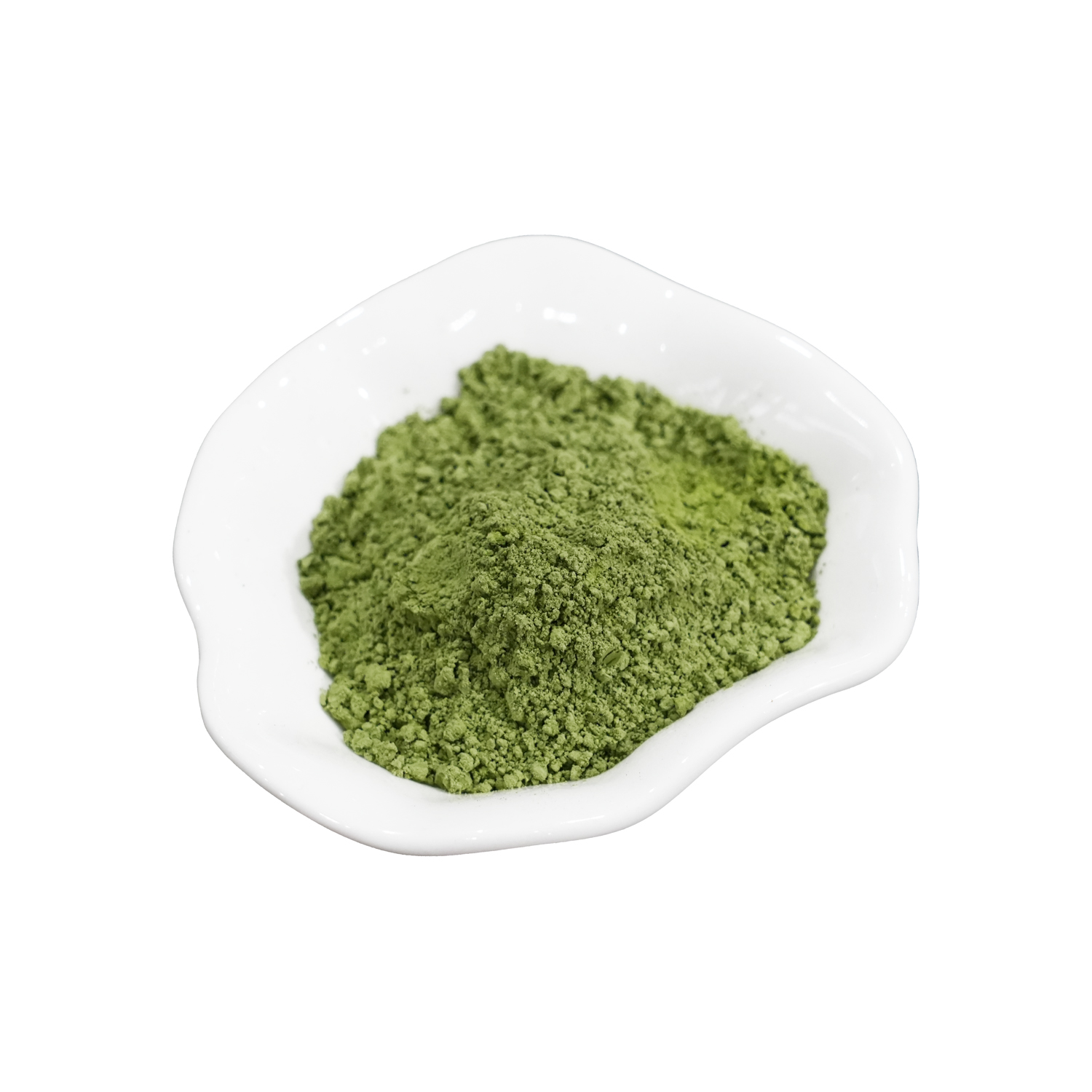
Matcha addition may change how a batter or dough handles, but there is no universal rule requiring a fixed extra tablespoon of liquid or fat.
Water, milk, butter and oil perform different functions. They are not interchangeable corrections for a dry result.
First compare the trial with the control. Check weighing, mixing, powder distribution and baking conditions. If a formulation adjustment is needed, change one ingredient at a time and record the effect.
Clumps can produce concentrated bitter spots while leaving other areas weakly flavored.
Evaluate sifting and dry blending, or a smooth dispersion made with a measured portion of the formula liquid. Choose the method compatible with the cake or cookie process.
A slurry must be included in the batch calculation. Adding unrecorded liquid can make dosage trials difficult to interpret.
Confirm distribution in both the raw mixture and the cooled product before concluding that more powder is required.
If a higher matcha dose tastes excessively bitter, reducing the dose or testing another powder may be more effective than adding sugar.
Sugar changes can also affect spread, moisture behavior, browning and structure. Evaluate the full formula when making an adjustment.
Likewise, dark sugars are not automatically unsuitable. Their color and flavor may suit a particular product, although they change the visual background against which the tea appears.
A brown surface does not establish that the matcha dose is too low. Increasing powder will not correct an uneven oven or reverse pigment changes.
Assess the crust and interior separately. Compare baking time, portion thickness, pan setup and heat distribution while ensuring that the product is adequately processed.
Do not impose one temperature ceiling on every matcha recipe. The appropriate profile depends on the complete product and equipment.
Before testing, define the required tea intensity, acceptable bitterness, appearance and texture.
Use coded samples where practical. Evaluate at a consistent time after cooling, then repeat the assessment during the intended selling period.
Keep the powder product code and batch number with each result. This connects the approved dose to the ingredient actually tested.
A short, consistent record makes trials easier to compare.
Record item | Why it matters |
|---|---|
Powder identity and batch | Connects the result to the tested material |
Ingredient weights | Allows the formula to be reproduced |
Percentage basis | Prevents scaling errors |
Mixing and holding conditions | Helps distinguish dosage from process effects |
Deposit weight and geometry | Supports a fair baking comparison |
Baking and cooling conditions | Explains differences in texture and appearance |
Sensory and storage results | Supports final product approval |
Move beyond the initial 2%, 3% and 4% screening points when the results justify it. Those levels are neither a complete application range nor a guarantee of the desired intensity.
Once a trial passes, scale every ingredient using the same factor. Preserve the approved powder specification and dosage basis.
Confirm the result on production equipment. Larger mixer loads, transfer systems, depositing and oven loading can change performance even when the formula remains proportional.
Review finished yield and consistency before releasing the formula for routine manufacture.
Calculate tea ingredient cost per batch using the purchase price and actual powder weight. Divide by saleable units to estimate cost per portion.
Include handling losses and rejected products when comparing alternatives. A less expensive powder does not automatically give a lower finished-product cost.
Review the Baker’s Kingdom matcha range with your recipe, process and cost target before approving a substitute.
Use the gram amount in an established recipe or supplier recommendation. A spoon conversion may be useful for that specific powder, but it should not replace weighing in commercial production. There is no universal teaspoon dose for an undefined batch.
Not automatically. Matcha and flour perform different functions. Record whether the powder is added or replaces another ingredient, then evaluate structure and handling. A successful replacement needs a complete formula trial.
Check the premix manufacturer’s guidance and the matcha supplier’s recommendation. Box sizes and compositions differ. Record additions relative to the specified dry mix or prepared batter weight rather than using one dose per “standard box.”
First check distribution and compare a modest dosage increase. Evaluate batter handling and the finished crumb before changing liquid or fat. A different powder may provide a better balance than repeatedly increasing the dose.
A direct replacement is not a reliable conversion. The ingredients differ in flavor and formulation behavior. Develop the matcha version using its own dosage trials rather than replacing a large cocoa quantity with the same weight of matcha.
For application guidance, contact Baker’s Kingdom with your cake or cookie formula, batch size, processing conditions and target tea intensity. Request current product information and samples for a controlled dosage trial.


