
English


Views: 0 Author: Site Editor Publish Time: 2026-11-03 Origin: Site


The best matcha powder for baking is the one that delivers the required flavor, appearance and texture in your actual recipe. Grade names, origin and raw powder color provide useful information, but none can establish baking performance alone.
Start by defining the product and reviewing the ingredient declaration. Then compare representative samples under consistent conditions and calculate cost at the approved dosage.
For commercial bakeries, café suppliers and food brands, this process creates a practical link between product development and purchasing. It also helps prevent a successful sample from becoming an inconsistent production ingredient.
Table of Contents
Tell the supplier whether you are developing a cake, cookie, bread, cream filling or chocolate-based component.
Include the mixing method, heating conditions, packaging and intended selling period. A powder selected for a chilled cream should not automatically be approved for a baked sponge.
Application | Main selection priority | What to check in the finished product |
|---|---|---|
Cakes and sponges | Flavor with a suitable crumb structure | Volume, texture, tea intensity and cooled color |
Cookies and biscuits | Tea character after baking | Spread, bite, browning and aftertaste |
Bread and sweet dough | Compatibility with the dough process | Handling, proofing, volume and flavor |
Creams and frostings | Smooth dispersion and clean flavor | Mouthfeel, sweetness balance and storage |
Chocolate-based components | Particle and moisture compatibility | Texture, processing behavior and flavor |
Pure tea powder gives the developer direct control over the tea addition. A formulated ingredient may offer a different combination of flavor, color or processing characteristics.
Neither should be selected without reviewing its composition. Request the complete ingredient declaration and confirm how it fits the formula and labeling requirements.
Baker’s Kingdom lists Bake-Stable Matcha Powder, with applications including matcha chiffon cake and custard bread. Ask for the specification of the exact variant being offered.
Its separate MT-06 Matcha Powder listing describes pure matcha with cold-processed applications. Discuss your process before choosing samples.
“Culinary,” “ceremonial,” “premium” and similar descriptions do not provide a complete specification shared across suppliers.
Ask what each term means within the supplier’s range. Request the differences in composition, sensory profile, particle characteristics, recommended use and price.
A drinking-oriented product may work in baking. A culinary-labeled product may still fail your requirements. The finished recipe should decide the approval.
Evaluate aroma, tea intensity, bitterness, astringency and aftertaste separately.
Butter, dairy, cocoa, nuts and fillings can change the perceived profile. A powder that tastes balanced in water may become weak or overly bitter in a finished dessert.
Strong astringency is not a requirement for successful baking. Select the profile that produces an acceptable product at the intended sweetness and richness.
If several products share one powder, evaluate each application before approving it across the range.
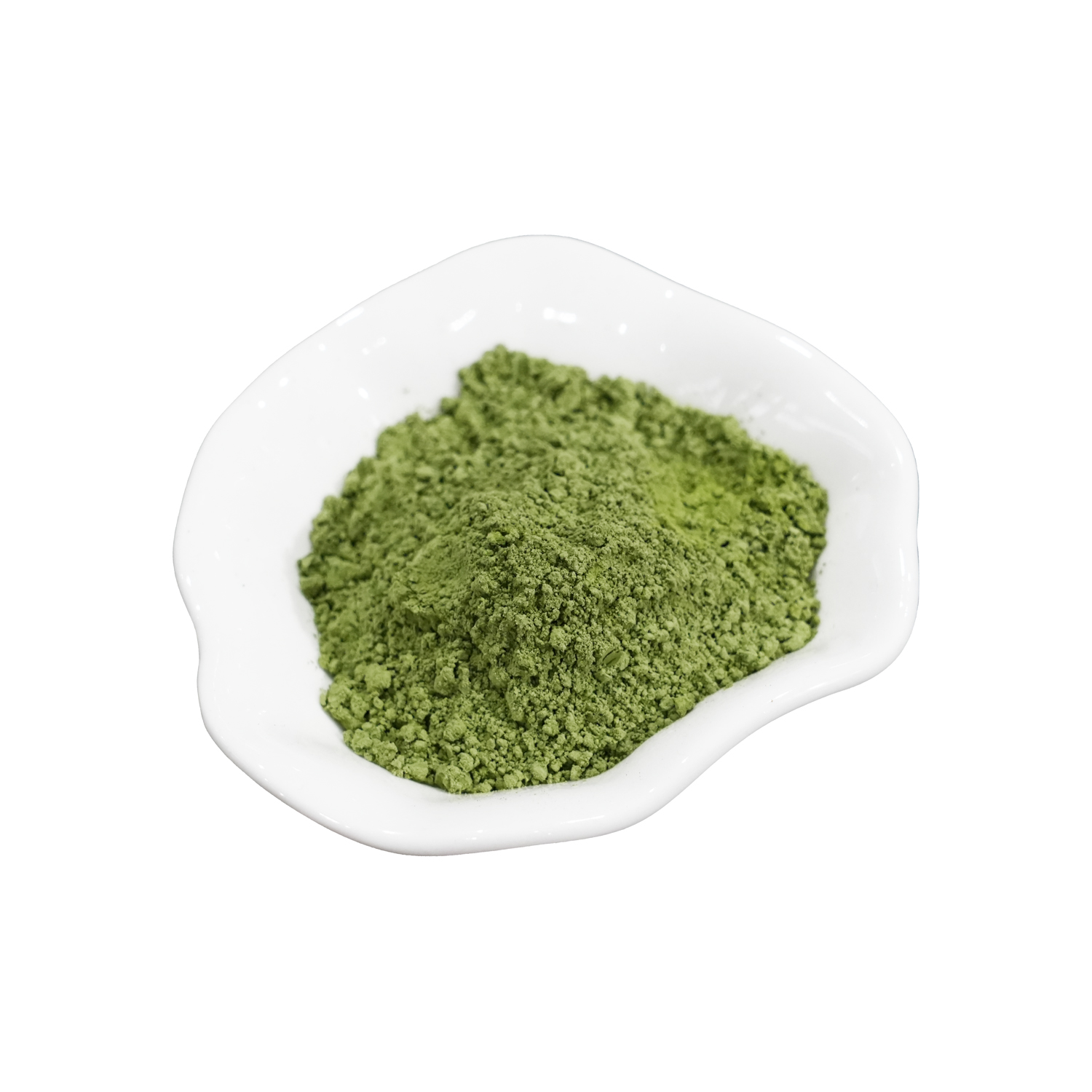
Inspect powder samples under consistent lighting and against the same background. Record differences without treating color as a complete quality diagnosis.
Then assess the cooled product. Compare the crust, underside and interior separately.
A bright raw powder does not guarantee a bright cake. Recipe composition, heating and storage can influence the result. Likewise, a difference in shade does not by itself prove oxidation, poor milling or an incorrect origin.
Use an approved product reference to define acceptable variation.
Request particle-size information and its measurement method. A mesh statement alone does not describe the complete particle distribution.
Verify performance through the application. Smooth creams and chocolate-based components can reveal particle perception differently from cakes or cookies.
Inspect the mixed dough or batter for clumps and streaks. Evaluate sifting and dry blending, or a dispersion made with a measured portion of recipe liquid.
Matcha disperses in a mixture; it does not completely dissolve like sugar. A smooth result depends on the powder and incorporation method together.
Origin may matter for sourcing policies, traceability or product positioning. Request documents that support any origin claim you intend to use.
Do not assume that one country automatically guarantees suitable baking performance. Likewise, a Japanese-style description does not establish Japanese origin.
Milling equipment alone is not a complete selection criterion. Review the documented process and specification, then confirm the result through testing.
Define the target before requesting samples. Include the product format, current formula, tea dosage, portion size and process.
Describe the required flavor and appearance using a reference product where possible. State whether the finished item will be sold fresh, chilled, frozen or packaged.
This gives the supplier a practical basis for shortlisting ingredients.
Record the product code and sample batch number. Use coded samples where practical so that packaging and price do not influence the first sensory assessment.
When comparing pure tea powders, an equal-weight addition can provide an initial screening point. It does not establish final dosage equivalence.
If the samples differ in composition, review those differences before designing the trial. A pure powder and a sweetened blend should not be treated as identical ingredients.
Keep the remaining ingredients, mixing, portioning, baking and cooling conditions consistent during the initial comparison.
Use a simple record to separate ingredient performance from processing variation.
Evaluation area | Useful observations |
|---|---|
Incorporation | Clumps, streaks, mixing effort and distribution |
Processing | Batter or dough consistency and handling |
Appearance | Cooled surface, interior and uniformity |
Sensory quality | Aroma, tea intensity, bitterness and aftertaste |
Structure | Volume, crumb, spread or filling texture |
Storage | Changes in flavor, appearance and texture |
Commercial result | Approved dosage and saleable yield |
Do not change powder, liquid, sugar and oven settings simultaneously. That makes the cause of an improvement difficult to identify.
After selecting promising samples, adjust dosage in separate trials.
There is no universal tablespoon amount for every cake or cookie. Weigh additions and state whether the percentage refers to flour, dry mix or total batter.
Confirm the final formula on production equipment. Where practical, compare additional ingredient lots before making a substantial purchasing commitment.
Evaluate the product through its intended selling period. Immediate post-bake performance is only part of the approval.
Price per kilogram does not show the complete ingredient cost.
Multiply the powder price by the quantity used in the approved batch. Divide by saleable portions to estimate tea ingredient cost per unit.
Then include handling losses, rejected products, freight and storage where relevant. A higher-priced powder may or may not offer better value; the finished-product result determines the comparison.
Avoid assuming that a premium label always permits a lower dose.
Choose a pack size that suits consumption and storage capacity. Repeatedly opening a large bag may create a different handling challenge from using smaller sealed units.
Ask about packaging construction, seal integrity and protection from moisture, light and oxygen. Review any vacuum or nitrogen-flushing information as part of the complete system.
Follow the specific product’s storage instructions. If refrigeration is recommended, establish handling that limits condensation during opening.
Ask for a current specification, complete ingredient declaration, storage instructions and shelf-life information.
Confirm the available batch documentation, traceability and quality information appropriate to the intended application and market.
If a certification or label claim matters, verify that the current document covers the exact ingredient. Do not infer certification from a broad product description.
Also agree how changes in composition, source or processing will be communicated.
Include the product format, destination market, expected dosage, processing conditions and target result.
Add the sample quantity needed, preferred packaging, projected usage, delivery requirements and document requests.
Review the Baker’s Kingdom matcha product range against that brief. Confirm sample options, minimum order quantity, lead time and quotation terms directly.
It is a useful category to explore, but the label alone cannot establish suitability. Compare actual samples for flavor, appearance, texture, handling and cost in the intended recipe.
Not necessarily. Pure powder and formulated ingredients serve different development needs. Review composition, dosage and labeling implications before selecting either. Avoid replacing one with the other without testing.
Request current product information and a representative sample. Run a controlled application trial, refine the dose and confirm production performance. Raw color and a paper-smear test cannot replace those checks.
Appearance alone cannot determine safety or establish the cause of a change. Check the product’s condition, dates, packaging and documentation. Investigate unexpected color or odor through your quality procedure before use.
Possibly, but each application needs evaluation. A common ingredient can simplify inventory only if it meets the requirements of every approved product. Test baked and unbaked uses separately.
To discuss ingredient selection, contact Baker’s Kingdom with your bakery application, processing conditions and purchasing requirements. Request relevant specifications and samples for evaluation in your own recipe.


