
English


Views: 0 Author: Site Editor Publish Time: 2026-11-04 Origin: Site


Consistent matcha cake production depends on coordinating ingredient selection, powder dispersion, batter aeration and baking conditions. A greener powder or a lower oven setting alone cannot guarantee a successful cake.
The first step is to define the cake format. A chiffon cake, butter cake and sheet sponge need different mixing procedures and quality targets. Each also responds differently to changes in tea dosage, liquid balance and processing time.
For commercial bakeries and food brands, the most useful approach is to begin with an established formula, compare tea ingredients under controlled conditions and document the process that produces an acceptable result.
Table of Contents
Define the cake’s structure, flavor intensity, portion size and selling conditions before choosing a powder.
Consider whether the cake will be sold plain, layered with cream, frozen for distribution or packaged for ambient storage. These decisions influence formulation, handling and shelf-life validation.
Cake format | Main development priority | Important trial observations |
|---|---|---|
Chiffon cake | Stable aeration and light structure | Foam handling, volume, shrinkage and crumb |
Butter cake | Balanced emulsion and tender texture | Batter consistency, grain, flavor and slicing |
Sheet sponge | Uniform thickness and flexibility | Deposit weight, baking uniformity and cracking |
Layer cake | Compatibility with fillings and coatings | Moisture migration, assembly and storage |
Marbled cake | Repeatable contrast and pattern | Batter flow, deposit ratio and layer movement |
Establish whether the proposed ingredient is pure tea powder or a formulated product. Differences in composition can affect dosage, sweetness, flavor and labeling.
Baker’s Kingdom lists Bake-Stable Matcha Powder, with matcha chiffon cake among its applications. Request the current specification and complete ingredient declaration for the exact variant being offered.
Its separate MT-06 Matcha Powder listing describes pure matcha with cold-processed applications. Discuss the baked cake and any unbaked filling separately when requesting samples.
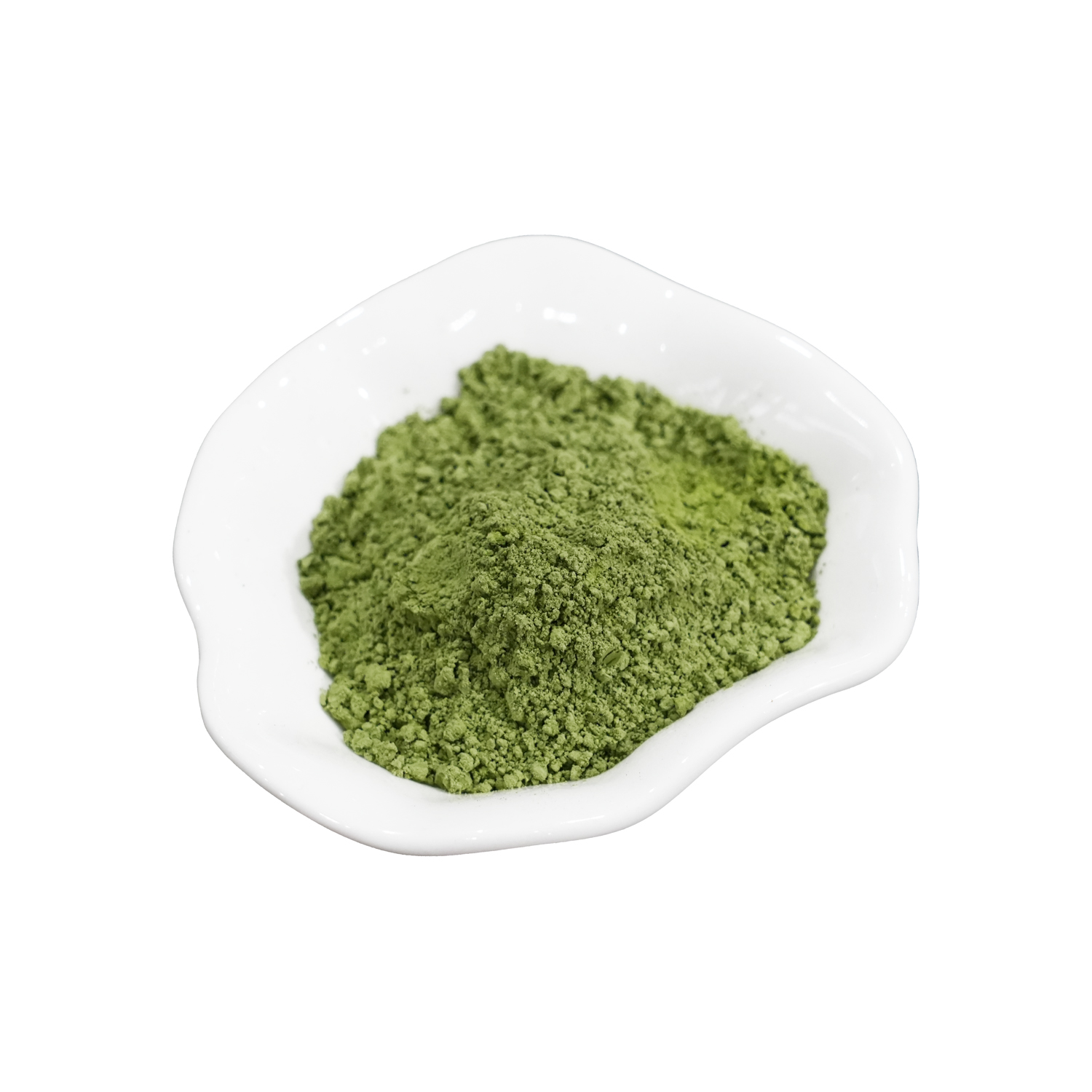
“Culinary” and “ceremonial” labels do not establish a universal particle size, harvest season or baking tolerance.
Compare samples in the intended cake formula. Record the product code, batch number, dosage and processing conditions. Assess the result after cooling and during the proposed selling period.
Calculate ingredient cost at the approved usage level. This provides a more useful comparison than price per kilogram alone.
Select flour according to the cake’s structural requirements. Protein content is useful information, but it does not describe every aspect of flour performance.
Butter, oil, eggs, milk and emulsifiers contribute different functions. Changing one can affect aeration, texture, flavor and processing behavior.
Avoid applying a fixed liquid increase whenever matcha is added. Likewise, baking soda and baking powder should be evaluated within the complete formula. Changing leavening solely to adjust color can introduce other defects.
Tea powder must be distributed evenly to avoid concentrated specks and uneven flavor. Sifting or dry blending can help break up agglomerates before final mixing.
A slurry made with a measured portion of the formula liquid is another option. It should be smooth enough for incorporation without adding unnecessary mixing or unplanned water.
Method | Potential benefit | What to verify |
|---|---|---|
Sifting and dry blending | Fits many established dry-ingredient workflows | Powder distribution, sieve suitability and losses |
Slurry incorporation | Allows dispersion to be checked before final mixing | Liquid accounting, temperature and compatibility |
Addition to one batter portion | Supports marbled or contrasting products | Extra handling, flow differences and aeration loss |
Neither method guarantees complete dispersion. Inspect the batter and baked crumb before approving the procedure.
A universal dry-to-wet sequence is unsuitable for every cake system.
Creamed cakes use a different aeration route from egg-foam cakes. Chiffon production combines a batter with whipped egg whites and requires controlled incorporation to retain the desired structure.
Start with the established mixing method for the formula. Define where the tea ingredient enters that sequence, then evaluate distribution and aeration together.
Record mixer type, attachment, loading, speed stages, ingredient temperatures and mixing endpoint. A fixed RPM or mixing time cannot be transferred reliably between all machines.
Batter specific gravity is the mass of batter divided by the mass of water occupying the same volume, measured using a defined procedure.
For example, if a container holds 100 g of water and the same volume of batter weighs 80 g, the calculated specific gravity is 0.80. This is a calculation example, not a target for matcha cake.
Use net weights after subtracting the container mass. Standardize filling, leveling, temperature and measurement timing.
Establish the acceptable range from successful trials for the selected cake. Specific gravity helps monitor aeration, but it does not replace a separate assessment of batter flow or stability.
Record the time between final mixing, depositing and oven entry. Compare samples taken across the expected production interval.
Longer holding can affect aeration, leavening behavior or consistency, depending on the formula. Establish a practical holding limit from trials rather than assuming every matcha batter must enter the oven within ten minutes.
Include transfer pumps, hoppers and depositors in scale-up checks because the complete handling route can influence the result.
Pan dimensions, material, preparation and batter depth affect heat transfer and cake structure.
Record deposit weight and distribution. Compare cake height, crust, internal texture and finished yield using the same setup.
When moving from a small test pan to a production tray, confirm the process again. A successful time and temperature combination does not automatically transfer to a different depth or loading pattern.
Surface browning and changes in tea pigments can both influence appearance. Recipe composition, heat exposure and storage also contribute.
Compare the crust and interior separately after cooling. Some surface browning may be acceptable for the chosen product.
Start with an established baking profile for the cake format. If the surface darkens excessively, investigate time, airflow, heat balance and pan configuration.
Any adjusted profile must still set the structure and adequately process the product. A single oven temperature or core-temperature reading cannot guarantee success across all cake types.
Cooling and depanning requirements vary. A delicate foam cake may need support or inversion, while another cake may be removed from its pan after a defined setting period.
Establish the method through trials that assess shrinkage, tearing, condensation and moisture loss.
Set validated conditions for filling, wrapping, refrigeration or freezing. Cakes with perishable components require a cooling and storage process suited to the complete product.
Batter freezing, baked-layer freezing and freezing an assembled cake are different processes.
If delayed production is required, compare the proposed process with a fresh control. Record freezing conditions, storage duration, thawing method and subsequent baking or assembly performance.
Approve the route using cake volume, crumb, color, flavor and handling results. Avoid assuming that all matcha batters are either suitable or unsuitable for freezing.
When adding matcha to one portion of a base batter, weigh the split and all subsequent additions.
Tea addition and extra mixing may change flow, aeration and deposit behavior. Compare both portions before baking and inspect the finished pattern.
Matching specific gravity alone does not guarantee identical flow or baking behavior. Record deposit sequence, portion ratio and the marbling action so operators can reproduce the design.
Use an approved cake reference and consistent evaluation conditions.
For instrumental color checks, Lab* measurements can help describe differences. Define the instrument setup, sampling location and acceptable variation. A more negative a* value indicates a greener direction, but it is not a complete quality score.
Measure moisture or water activity when relevant to the product specification. State the method and reporting basis rather than using an undefined “moisture retention rate.”
Observation | Variables to investigate | Useful verification |
|---|---|---|
Green specks or streaks | Agglomerates, mixing sequence, distribution | Inspect batter and cut crumb |
Dense or uneven crumb | Aeration, emulsion, holding and baking | Compare specific gravity and process records |
Excessive bitterness | Ingredient identity, dosage, distribution | Conduct controlled sensory comparisons |
Uneven color | Mixing, pan depth, heat distribution | Compare positions within the same run |
Shrinkage or collapse | Structure, bake endpoint and cooling support | Review the complete process |
Test the cake in its intended packaging, distribution and display conditions. Assess color, flavor, texture and appropriate microbiological criteria.
Light protection, barrier properties and atmosphere control may be relevant options. Their value must be demonstrated for the actual product.
A plain cake and a cream-filled layer cake need different evaluations. Neither the powder’s shelf life nor a packaging method establishes a guaranteed finished-cake selling period.
Provide the cake format, batch size, tea dosage, mixing method, baking profile and target appearance. Include fillings, packaging, distribution conditions, intended market and expected order quantity.
Review the Baker’s Kingdom matcha product range against those requirements. Request current documentation and samples before approving a production ingredient.
Choose the powder that meets the required composition, flavor, appearance and cost targets in your actual formula. Grade labels alone are insufficient. Compare supplier samples through a documented baking trial.
Evaluate sifting and dry blending or a slurry made with measured formula liquid. Choose the method compatible with the cake’s mixing sequence. Confirm distribution in both the batter and baked crumb.
The target depends on the cake system and formula. Establish it from successful trials using a consistent measurement method. A chiffon cake and a butter cake should not automatically share one target.
No fixed adjustment applies to every powder and formula. Evaluate consistency, aeration, cake volume and eating quality before changing liquid. Added water, milk and oil perform different functions and are not interchangeable corrections.
Ingredient characteristics, recipe chemistry, baking and storage can all influence color. Compare raw batter, cooled cake and stored samples to identify when the change occurs. Adjust one variable at a time while checking texture and flavor.
To discuss ingredients for your cake range, contact Baker’s Kingdom with your formulation and processing requirements. Request current specifications and samples for evaluation in your own production process.


